Applications of Value Stream Mapping (VSM) in Process Plant Design
Process plant design is often approached as an exercise in equipment selection, process simulation, piping and instrumentation, utility integration, control strategy, and plant layout. These are undeniably important, but a technically sound process design can still produce an inefficient plant if the overall flow of materials, information, decisions, energy, and operating activities is poorly structured. This is where Value Stream Mapping (VSM) becomes particularly valuable. Originally developed within the Lean Manufacturing philosophy, VSM provides a visual representation of how value is created and how resources move through a process from the arrival of inputs to the delivery of the final product. Although it is commonly associated with manufacturing operations, its principles are highly applicable to chemical, petrochemical, pharmaceutical, food-processing, water-treatment, energy, and other process plants.
In process plant design, VSM encourages engineers to look beyond individual equipment items and ask a more fundamental question: How does the entire plant create value, and where does the process consume time, energy, materials, information, and capital without contributing directly to that value? This perspective can significantly influence process configuration, equipment sizing, plant layout, material handling, inventory strategy, control philosophy, utility design, maintenance planning, and even the way information flows between operations and management. The real strength of VSM in process plant design is therefore not simply that it identifies waste. It helps designers understand the relationship between process flow and value creation before the plant is built. Understanding Value Stream Mapping in the Context of Process Plants
A value stream represents the complete sequence of activities required to transform raw materials into a product that satisfies customer or process requirements. In a conventional manufacturing environment, this may involve receiving raw materials, production, inspection, storage, packaging, and dispatch. For a process plant, the value stream is more complex because material transformation is frequently continuous rather than discrete.
A crude-oil refinery, for example, does not simply move individual units from one workstation to another. Feedstock passes continuously through storage tanks, pumps, heat exchangers, furnaces, reactors, separators, columns, compressors, and other equipment. Consequently, VSM in process plant design should be interpreted broadly.
Download Engineering Design Kits & Process Equipment/Plant Design Excel Templates Here.
The "flow" being mapped may include:
- Raw-material movement.
- Intermediate material transfer.
- Product flow.
- Utility and energy flow.
- Information and control signals.
- Sampling and laboratory activities.
- Maintenance activities.
- Material waiting and storage.
- Quality-control activities.
- Waste and rework streams.
- Decision-making and approval processes.
This broader interpretation makes VSM especially useful during conceptual and detailed plant design because it provides a system-level view of the proposed facility. Instead of asking only whether a reactor has been correctly designed, the engineer can ask whether the reactor's location, upstream and downstream equipment, residence time, buffer capacity, control requirements, and material-transfer arrangements support an efficient overall value stream.
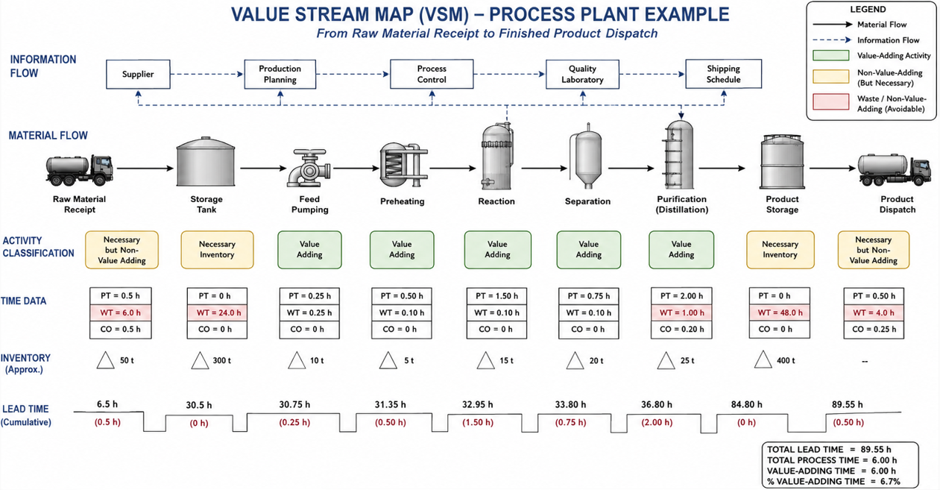
Figure 1: Value Stream Mapping of a typical continuous process plant from raw-material receipt to finished-product dispatch.
Figure 1 illustrates how Value Stream Mapping can be adapted to a continuous process plant by integrating material flow, information flow, processing activities, waiting periods, inventory levels, and cumulative lead time. The map demonstrates that the physical transformation of material represents only part of the total production lead time, thereby helping process designers identify excessive waiting, unnecessary inventory, and other opportunities for improving the overall value stream. So, VSM provides a system-level perspective that conventional process flow diagrams may not fully capture, particularly by making waiting time, inventory accumulation, information flow, and other sources of non-value-adding activity visible. VSM as a Bridge Between Process Design and Lean Thinking
Traditional process design is strongly concerned with satisfying technical constraints. The plant must achieve the required conversion, capacity, pressure, temperature, separation efficiency, product specification, safety requirements, and environmental performance. Lean design adds another dimension: the process should achieve these objectives with minimum unnecessary consumption of resources. This does not mean designing the smallest possible plant or eliminating every form of inventory. In process industries, some inventories, buffers, redundancy, residence times, and equipment duplication are necessary for safety, reliability, operability, and process stability.
The objective is instead to distinguish between necessary process requirements and avoidable waste. For example, a buffer tank may be essential because an upstream continuous process must remain operational while a downstream batch operation is temporarily unavailable. That tank represents inventory, but it may be value-supporting inventory. Conversely, excessive intermediate storage caused by poor process synchronization may represent avoidable waste. VSM helps designers make this distinction.
Download Engineering Design Kits & Process Equipment/Plant Design Excel Templates Here.
Application of VSM During Conceptual Process Design
One of the most powerful applications of VSM is during the early stages of plant development, when major design decisions have not yet become expensive to change. At the conceptual stage, engineers can develop a preliminary value stream map showing how raw materials enter the facility, how they are transformed, where they wait, how information is exchanged, and how the finished product leaves the plant. This can reveal inefficiencies that may otherwise remain hidden in conventional process flow diagrams. For example, a process flow diagram may show that a product moves logically from Reactor A to Separator B and then to Storage C. However, a VSM-based analysis may reveal that the product requires several hours of intermediate holding, repeated sampling, manual approval, and additional transfer before it can proceed.
The process flow diagram is technically correct, but the value stream reveals an inefficient operating system. At this stage, designers can investigate alternatives such as:
- Reducing unnecessary intermediate storage.
- Integrating process steps.
- Relocating equipment.
- Increasing process synchronization.
- Automating information transfer.
- Eliminating unnecessary inspection loops.
- Reducing unnecessary material transfers.
- Reconsidering batch sizes.
- Improving equipment availability.
Making these changes during conceptual design is considerably easier than attempting to correct them after construction.
Identifying Waste in Process Plant Design
One of the most important contributions of VSM is its ability to expose the different forms of waste embedded within a proposed process. The traditional Lean framework identifies wastes such as overproduction, waiting, transportation, overprocessing, inventory, motion, defects, and underutilized human capability. In a process plant, these concepts need to be interpreted according to the characteristics of continuous and batch processing.
- Waiting
Waiting can occur when materials remain in tanks because downstream equipment is unavailable, when laboratory results delay product release, or when operators wait for permits, approvals, maintenance intervention, or process stabilization. A plant may have excellent equipment utilization while still suffering substantial waiting time across the value stream. VSM makes this visible by showing the difference between actual processing time and total elapsed time.
- Excessive Inventory
Process plants often require inventories for operational stability, but excessive raw-material, intermediate, or finished-product inventory ties up capital and consumes storage capacity. A VSM study can examine whether inventory exists because of genuine process requirements or because upstream and downstream operations have not been properly synchronized. This is particularly important in plants involving expensive feedstocks, hazardous materials, refrigerated products, or products with limited shelf life.
- Unnecessary Transportation
Poor plant layout can force materials to travel unnecessarily long distances. This may involve excessive pumping, repeated transfer between tanks, long conveyor routes, unnecessary forklift movement, or multiple intermediate storage points. VSM helps designers visualize these movements and question whether they create value.
- Overprocessing
Overprocessing occurs when a process performs more work than necessary to satisfy customer or specification requirements. Examples include unnecessary purification, excessive recirculation, redundant sampling, excessive manual documentation, or processing materials to a tighter specification than the customer requires. In process plant design, this can have major implications because overprocessing frequently consumes energy, chemicals, utilities, equipment capacity, and operating time.
- Defects and Rework
A poorly designed process can generate off-specification products that require reprocessing, blending, disposal, or downgrading. VSM can connect these quality problems to their position within the overall process rather than treating them as isolated production events. This is important because preventing a defect upstream is usually more valuable than detecting it after the product has passed through several downstream operations.
Download Engineering Design Kits & Process Equipment/Plant Design Excel Templates Here.
VSM and Process Flow Diagram Development
The Process Flow Diagram (PFD) remains one of the central documents in process plant design. However, the PFD primarily describes what flows where and under what process conditions. VSM complements this by asking how efficiently that flow creates value. For example, a PFD may identify: Raw Material → Preheater → Reactor → Cooler → Separator → Purification → Product Storage. A VSM overlay can add information such as:
- Processing time.
- Waiting time.
- Inventory levels.
- Equipment availability.
- Changeover time.
- Quality inspection points.
- Material-transfer frequency.
- Information delays.
- Rework rates.
- Energy consumption.
- Production lead time.
The result is a more complete understanding of the proposed process. This is particularly useful when comparing alternative process configurations. Two designs may produce the same quantity and quality of product, yet one may have significantly less waiting, lower intermediate inventory, fewer transfers, and a shorter overall lead time. VSM helps make these differences visible.
VSM in Equipment Selection and Sizing
Equipment design is normally driven by material and energy balances, design capacity, operating conditions, safety factors, and mechanical requirements. However, VSM can provide an additional basis for equipment decisions. Consider storage tanks. Traditional sizing may determine tank volume from feed rate, operating requirements, residence time, surge requirements, and safety considerations. A VSM analysis can additionally examine whether the proposed inventory is actually necessary for the value stream. Similarly, excessive buffer capacity may appear attractive because it provides operational flexibility. However, it can also increase capital expenditure, footprint, residence time, product degradation risk, pumping requirements, and working capital. VSM therefore encourages engineers to distinguish between strategic buffering and wasteful accumulation.
The same principle applies to pumps, conveyors, heat exchangers, reactors, separators, packaging systems, and other equipment. The objective is not simply to size equipment correctly but to ensure that equipment capacities are properly synchronized.
Improving Process Synchronization
One of the most important applications of VSM is balancing different stages of a process. Suppose an upstream reactor can produce 10 tonnes per hour while a downstream purification unit can process only 7 tonnes per hour. The resulting imbalance will eventually create accumulation, waiting, or production constraints. Alternatively, if the purification unit can process 15 tonnes per hour, the additional capacity may remain underutilized unless there is a justified reason for the mismatch. VSM helps identify such imbalances across the value stream. This is particularly important for plants containing combinations of continuous and batch operations.
A continuous process may operate steadily while a downstream batch unit operates intermittently. Without appropriate synchronization and buffer management, this can create unnecessary inventory and waiting. A well-designed VSM can therefore support decisions regarding:
- Buffer sizes.
- Batch sizes.
- Cycle times.
- Equipment capacity.
- Production scheduling.
- Operating windows.
- Changeover strategy.
- Maintenance intervals.
Download Engineering Design Kits & Process Equipment/Plant Design Excel Templates Here.
VSM and Plant Layout Optimization
Plant layout has a direct effect on material movement, piping length, pumping requirements, maintenance accessibility, operator movement, construction cost, and safety. VSM provides a useful basis for evaluating layout alternatives because it focuses attention on the actual movement of materials and people. A poorly arranged plant may cause materials to move repeatedly between distant process areas. Long transfer routes can increase pressure losses and pumping energy while also increasing piping costs and the number of potential leak points. A VSM-oriented layout approach seeks to create a more coherent flow. This does not necessarily mean placing every piece of equipment in a straight line. Process safety, hazardous-area classification, fire protection, maintenance access, structural requirements, drainage, environmental considerations, and future expansion must remain central to the design.
Rather, VSM provides an additional criterion: Does the physical arrangement support an efficient value stream?VSM in Energy and Utility Optimization
Energy is one of the highest operating costs in many process industries. VSM can contribute to energy efficiency by connecting energy consumption to process flow. Instead of looking at individual equipment energy consumption in isolation, engineers can investigate where energy is consumed throughout the value stream and whether that consumption contributes directly or indirectly to product creation. For example, unnecessary pumping caused by excessive transfer distances can increase electricity consumption. Excessive intermediate storage may require additional heating, cooling, agitation, or refrigeration. Repeated processing may consume additional steam and cooling water. Similarly, poor synchronization can cause equipment to operate at low loads, where efficiency may deteriorate.
When integrated with processes such as Pinch Analysis, energy balances, utility system analysis, and heat-integration studies, VSM can help establish a stronger connection between lean operation and energy-efficient plant design. The question becomes not simply "Where is energy consumed?" but "Why is this energy being consumed, and does it support value creation?"
VSM and Process Control Automation
Modern process plants depend heavily on instrumentation, distributed control systems, supervisory systems, sensors, alarms, laboratory information systems, and other digital technologies. Yet automation does not automatically eliminate waste. A plant can have sophisticated automation while still suffering from poor information flow. VSM can be used to examine how information moves through the plant. For example, production data may be collected automatically but still require manual transcription before reaching the planning department. Laboratory results may be available digitally but may require several approval steps before production can respond.
These information delays can become operational bottlenecks. VSM therefore supports the design of more integrated information flows, particularly when combined with Industry 4.0, Industrial Internet of Things (IIoT), Manufacturing Execution Systems (MES), digital twins, and advanced process control. The objective is to ensure that the right information reaches the right decision-maker at the right time.
VSM and Quality-by-Design
Quality should not be treated as something inspected into the product at the end of production. It should be built into the process. VSM supports this philosophy by mapping where quality decisions occur and how defects move through the process. For example, if a critical product parameter is measured only after several downstream operations have already occurred, an off-specification condition may generate significant waste. An improved design may introduce appropriate in-process monitoring and control so that deviations are detected and corrected closer to their point of origin. This principle is particularly important in pharmaceutical, food, chemical, and specialty chemical manufacturing, where quality deviations can be expensive and regulatory consequences may be significant.
Download Engineering Design Kits & Process Equipment/Plant Design Excel Templates Here.
VSM and Process Safety
Although VSM is primarily a Lean methodology, it can also contribute to process safety when applied carefully. Unnecessary material transfers, excessive inventories, repeated handling, congested layouts, manual interventions, and complex process routes can introduce additional opportunities for human error and equipment failure. Reducing unnecessary complexity can therefore improve both efficiency and safety. For example, minimizing the number of manual transfers of hazardous chemicals can reduce operator exposure. Reducing unnecessary storage can decrease the inventory of hazardous substances.
Simplifying material routing can reduce the possibility of incorrect line-up or transfer. However, VSM should not be used as a substitute for formal process-safety methodologies such as HAZOP, LOPA, HAZID, QRA, or risk assessment. Instead, it should complement them. The Lean objective of eliminating waste must never override safety requirements. A safety-critical redundancy, isolation system, emergency shutdown function, or minimum required inventory should not be removed simply because it appears to be "non-value-adding."
VSM in Maintenance and Reliability Engineering
Equipment reliability strongly influences the performance of a process plant. A failed pump, compressor, heat exchanger, control valve, or reactor can interrupt the entire value stream. VSM helps show how equipment downtime propagates through upstream and downstream operations. For example, a failed compressor may not only stop the compressor itself. It may cause upstream accumulation, downstream starvation, reduced production, additional flaring, increased energy consumption, and delayed product delivery. This systems perspective is useful for developing maintenance strategies. The plant designer can use VSM alongside Reliability-Centred Maintenance (RCM), Total Productive Maintenance (TPM), Failure Mode and Effects Analysis (FMEA), and predictive maintenance to identify equipment whose failure has the greatest impact on the overall value stream. This supports more intelligent decisions about redundancy, spare capacity, instrumentation, condition monitoring, and maintenance accessibility.
VSM and Human Factors
A process plant is not operated by equipment alone. Operators, technicians, engineers, laboratory personnel, maintenance teams, supervisors, and planners interact continuously with the system. VSM can expose unnecessary human movement, repetitive data entry, excessive approvals, manual inspection activities, and communication gaps. This is important because poorly designed work systems often transfer inefficiency to people. For instance, if an operator must physically travel between several locations simply to collect readings that could be transmitted electronically, the problem is not operator performance. It may be a design problem. Likewise, if several departments independently record the same production information, the duplication may indicate an information-system design weakness. Effective VSM therefore treats people as part of the value stream rather than as an afterthought.
Download Engineering Design Kits & Process Equipment/Plant Design Excel Templates Here.
VSM for Batch Process Design
VSM is especially useful for batch plants because batch operations naturally contain waiting, changeover, cleaning, inspection, and scheduling activities. A pharmaceutical, food, specialty chemical, or polymer plant may spend only a fraction of its total production lead time actually transforming the material. The remainder may involve waiting for equipment availability, cleaning, sampling, laboratory analysis, approval, transfer, or preparation for the next batch. VSM makes these hidden time losses visible. Once identified, engineers can investigate alternatives such as:
- Reducing cleaning and changeover times.
- Improving scheduling.
- Increasing equipment flexibility.
- Introducing parallel equipment where justified.
- Reducing unnecessary quality hold points.
- Improving material staging.
- Automating repetitive operations.
The result can be a shorter production lead time without necessarily increasing nominal equipment capacity.
VSM and Debottlenecking
Debottlenecking is often approached by identifying the equipment with the lowest capacity relative to the required production rate. VSM provides a broader perspective. The true bottleneck may not always be a single piece of equipment. It may be caused by scheduling, material availability, laboratory approval, maintenance, changeover, transfer capacity, or information flow. For example, a reactor may have sufficient capacity, but if raw material preparation takes too long, the reactor may remain starved. Alternatively, the reactor may operate efficiently while downstream product certification creates a prolonged hold-up. VSM can therefore distinguish between equipment bottlenecks and system bottlenecks. This distinction is crucial when deciding where capital should be invested.
Future-State Mapping and Process Plant Optimization
A major strength of VSM is that it does not stop at describing the existing state. It encourages the development of a future-state map. In plant design, this means developing an improved representation of how the proposed plant should operate. The current-state map identifies existing or anticipated problems, while the future-state map represents the desired flow after waste reduction and process improvements. The future-state design may involve:
- Reduced lead time.
- Lower intermediate inventory.
- Improved process synchronization.
- Better equipment utilization.
- Reduced material handling.
- More efficient information flow.
- Reduced energy consumption.
- Improved quality control.
- Reduced manual intervention.
This future-state perspective is particularly valuable for greenfield projects because it allows the design team to build lean principles into the plant from the beginning rather than attempting to retrofit them later.
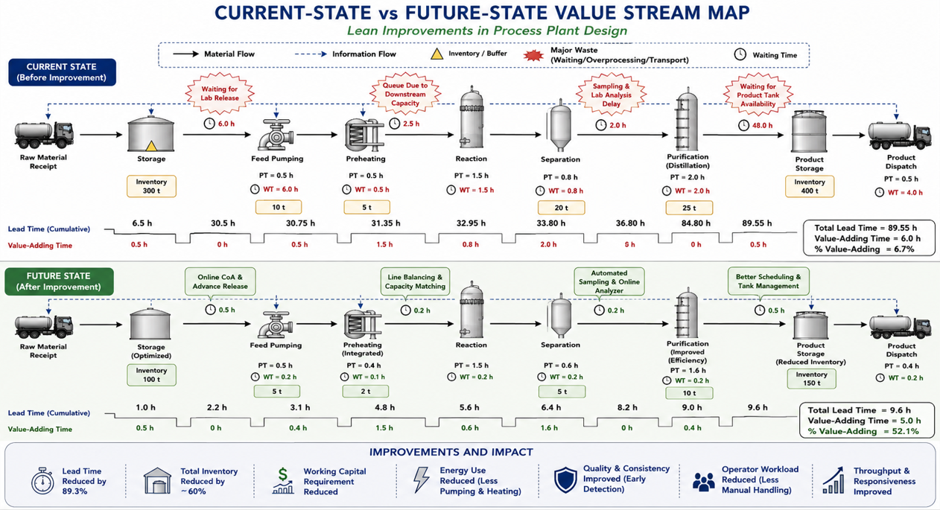
Figure 2: Comparison of current-state and future-state value stream maps for process plant optimization.
Figure 2 illustrates the transition from a current-state value stream to a future-state process plant design. By addressing waiting time, excessive inventory, information delays, process imbalance, and other non-value-adding activities, the future-state configuration demonstrates how VSM can translate identified sources of waste into specific engineering and operational improvements. The comparison demonstrates an important principle of VSM: the objective is not merely to document existing waste, but to use the information generated by the current-state map to develop a more synchronized, responsive, and resource-efficient future-state process.
Download Engineering Design Kits & Process Equipment/Plant Design Excel Templates Here.
VSM in Greenfield and Brownfield Projects
The application of VSM differs depending on whether a project involves a new plant or an existing facility. In a greenfield project, VSM can influence the design before major capital commitments are made. Engineers can compare alternative layouts, process configurations, storage strategies, equipment capacities, and information flows. In a brownfield project, the existing value stream can be mapped to identify where the plant is currently losing time, materials, energy, capacity, and information. The results can then guide expansion, modification, debottlenecking, or modernization. Brownfield VSM can be particularly revealing because many inefficiencies have accumulated over years of operational changes. A plant may contain equipment that was originally necessary but has become redundant, pipelines that no longer reflect the current production strategy, oversized storage systems, duplicated inspection activities, or manual procedures that could now be digitized.
Integrating VSM with Other Process Engineering Tools
VSM should not be regarded as a replacement for established process engineering methods. Its greatest value comes from integration. A strong process design methodology can combine VSM with:
- Process Simulation: to evaluate mass, energy, hydraulic, and thermodynamic performance.
- PFDs and P&IDs: to establish process configuration, equipment connections, instrumentation, and control.
- Pinch Analysis: to optimize heat recovery and utility consumption.
- HAZOP and LOPA: to identify and manage process hazards.
- FMEA: to evaluate equipment and system failure modes.
- Six Sigma: to reduce process variation and defects.
- OEE: to evaluate equipment availability, performance, and quality.
- Life-Cycle Cost Analysis: to compare capital and operating costs.
- Digital Twin Technology: to simulate and optimize the plant throughout its lifecycle.
The resulting approach is much stronger than applying any single methodology independently.
A Practical VSM Approach for Process Plant Designers
A practical VSM exercise can begin by defining the product family or process route being studied. The design team should then establish the major process stages from raw-material receipt to final product delivery. For each stage, relevant information such as cycle time, residence time, waiting time, inventory, equipment availability, changeover requirements, quality checks, energy consumption, and information flow can be documented. The team should then identify where the value stream experiences interruptions, accumulation, unnecessary movement, repeated processing, quality losses, or information delays. The next step is to distinguish necessary process requirements from avoidable waste. This distinction is critical. Process industries cannot simply eliminate every storage tank, inspection point, recirculation loop, or buffer. Some exist because of physics, safety, quality, reliability, or operational flexibility. Finally, the design team develops a future-state value stream and evaluates the proposed improvements technically and economically. The outcome should not merely be a visually attractive map. It should lead to measurable design decisions.
Download Engineering Design Kits & Process Equipment/Plant Design Excel Templates Here.
Measuring the Benefits of VSM
The effectiveness of VSM should ultimately be demonstrated through measurable performance indicators. Relevant indicators in process plant design may include:
- Production lead time.
- Process cycle time.
- Equipment utilization.
- Overall Equipment Effectiveness.
- Intermediate inventory.
- Energy consumption per unit of product.
- Water consumption per unit of product.
- Material yield.
- Product rejection rate.
- Rework rate.
- Changeover time.
- Unplanned downtime.
- Material-transfer distance.
- Pumping requirements.
- Production throughput.
- Maintenance response time.
These indicators allow engineers to determine whether a proposed design actually creates a better value stream.
Challenges in Applying VSM to Process Plants
Despite its benefits, VSM should not be applied mechanically. The first challenge is that process plants often operate continuously, making traditional manufacturing concepts such as cycle time and takt time less straightforward. Another challenge is that some apparent waste is actually necessary for safety, reliability, quality, or process stability. There is also a danger of optimizing individual process units while damaging the overall system. Increasing the capacity of one unit, for example, may simply move the bottleneck downstream. Data availability can also be a problem, particularly in older plants where accurate information about downtime, inventory, energy consumption, and process variability may not be readily available. Finally, successful VSM requires cross-functional participation. Process engineers alone may not understand every operational constraint. Operators, maintenance personnel, quality professionals, production planners, safety specialists, and management should contribute to the analysis.
The Strategic Value of VSM in Modern Process Plant Design
The deeper significance of VSM is that it changes the way engineers think about plant design. A conventional approach may ask: Can the plant produce the required product at the required capacity? A VSM-oriented approach asks a more demanding set of questions: How quickly does value move through the plant? Where does it stop? Why does it stop? What resources are consumed while it waits? Which activities create value, which are necessary but non-value-adding, and which are simply waste? Can the process be designed to achieve the required output with less material, energy, time, movement, inventory, and complexity? These questions are increasingly important as process industries face pressure to improve productivity while simultaneously reducing energy consumption, carbon emissions, operating costs, waste generation, and environmental impact. Lean process design is therefore no longer simply an operational improvement philosophy. It can become a plant-design philosophy.
Download Engineering Design Kits & Process Equipment/Plant Design Excel Templates Here.
Conclusion
Value Stream Mapping provides process plant designers with a powerful systems-level method for understanding how materials, information, energy, people, and decisions move through a production system. Its application extends well beyond identifying obvious operational waste. Properly used, VSM can influence process configuration, equipment sizing, storage requirements, plant layout, utility consumption, automation, quality management, maintenance strategy, debottlenecking, and overall plant performance. Its greatest contribution is perhaps its ability to expose the difference between processing activity and value creation. A reactor may transform material, a pump may move it, a tank may store it, a laboratory may analyse it, and an operator may monitor it, but not every activity necessarily moves the product closer to what the customer needs. For process engineers, this distinction is extremely important.
The most effective plant is not necessarily the one with the most sophisticated equipment or the highest installed capacity. It is the plant in which the flow of materials, energy, information, and decisions is deliberately designed around value creation, safety, quality, reliability, and efficiency. When VSM is integrated with process simulation, process safety, energy analysis, Six Sigma, reliability engineering, automation, and life-cycle economic assessment, it becomes much more than a Lean manufacturing tool. It becomes a practical framework for designing process plants that flow better, consume fewer resources, respond faster, and deliver greater value throughout their operating life. Ultimately, the principle is simple but powerful: do not wait until a process plant is operating before asking where the waste is.
Design the value stream correctly from the beginning.
References
- Liker, J. K. (2004). The Toyota way: 14 management principles from the world's greatest manufacturer. McGraw-Hill.
- Rother, M., & Shook, J. (2003). Learning to see: Value-stream mapping to create value and eliminate muda (Version 1.3). Lean Enterprise Institute.
- Shah, R., & Ward, P. T. (2007). Defining and developing measures of lean production. Journal of Operations Management, 25(4), 785–805. https://doi.org/10.1016/j.jom.2007.01.019
- Womack, J. P., & Jones, D. T. (2003). Lean thinking: Banish waste and create wealth in your corporation (Rev. ed.). Free Press.
- Ohno, T. (1988). Toyota production system: Beyond large-scale production. Productivity Press.
- Shingo, S. (1989). A study of the Toyota production system: From an industrial engineering viewpoint. Productivity Press.
- Hines, P., & Taylor, D. (2000). Going lean: A guide to implementation. Lean Enterprise Research Centre, Cardiff Business School.
- Hines, P., Holweg, M., & Rich, N. (2004). Learning to evolve: A review of contemporary lean thinking. International Journal of Operations & Production Management, 24(10), 994–1011. https://doi.org/10.1108/01443570410558049
- Womack, J. P., Jones, D. T., & Roos, D. (1990). The machine that changed the world: The story of lean production. Rawson Associates.
- Shah, R., & Ward, P. T. (2003). Lean manufacturing: Context, practice bundles, and performance. Journal of Operations Management, 21(2), 129–149. https://doi.org/10.1016/S0272-6963(02)00108-0
- Bhamu, J., & Singh Sangwan, K. (2014). Lean manufacturing: Literature review and research issues. International Journal of Operations & Production Management, 34(7), 876–940. https://doi.org/10.1108/IJOPM-08-2012-0315
- Hines, P., & Rich, N. (1997). The seven value stream mapping tools. International Journal of Operations & Production Management, 17(1), 46–64. https://doi.org/10.1108/01443579710157989
- Abdulmalek, F. A., & Rajgopal, J. (2007). Analyzing the benefits of lean manufacturing and value stream mapping via simulation: A process sector case study. International Journal of Production Economics, 107(1), 223–236. https://doi.org/10.1016/j.ijpe.2006.09.009
- Seth, D., & Gupta, V. (2005). Application of value stream mapping for lean operations: An Indian case study. International Journal of Advanced Manufacturing Technology, 26, 877–882. https://doi.org/10.1007/s00170-004-2412-7
- Singh, B., Garg, S. K., & Sharma, S. K. (2011). Value stream mapping: Literature review and implications for Indian industry. International Journal of Advanced Manufacturing Technology, 53, 799–809. https://doi.org/10.1007/s00170-010-2860-7
- Melton, T. (2005). The benefits of lean manufacturing: What lean thinking has to offer the process industries. Chemical Engineering Research and Design, 83(A6), 662–673. https://doi.org/10.1205/cherd.04351
- Feld, W. M. (2001). Lean manufacturing: Tools, techniques, and how to use them. CRC Press.
- George, M. L. (2003). Lean Six Sigma for service: How to use Lean Speed and Six Sigma Quality to improve services and transactions. McGraw-Hill.
- Mann, D. (2015). Creating a Lean culture: Tools to sustain Lean conversions (3rd ed.). Productivity Press.
- Dennis, P. (2017). Lean production simplified: A plain-language guide to the world's most powerful production system (3rd ed.). Productivity Press.