Applying ISO 9001 Standards in Process Design: Building Quality into the Process
Quality should not be something we inspect into a product after production. It should be something we design into the process from the beginning.
This principle is particularly important in chemical, manufacturing, energy, pharmaceutical, food, water treatment, and other process industries, where a poorly designed process can result in inconsistent product quality, excessive waste, equipment failures, high operating costs, environmental problems, and customer dissatisfaction.
ISO 9001 provides a useful framework for addressing these challenges. Although ISO 9001 is widely recognized as a quality management system standard, its principles can be applied much earlier than the production stage—particularly during process design.
When ISO 9001 principles are integrated into process engineering, quality becomes part of the design philosophy rather than merely the responsibility of the Quality Assurance department.
Why Quality Must Begin at the Design Stage
Many industrial quality problems are actually design problems.
If a reactor is incorrectly sized, a pump is improperly selected, a heat exchanger lacks sufficient capacity, an instrument has inadequate accuracy, or a control strategy is poorly developed, operators may spend years trying to manage problems that should have been eliminated during design.
This is why process engineers should ask an important question before finalizing a design:
"What could prevent this process from consistently producing the required output?"
The answer should influence equipment selection, process configuration, instrumentation, control systems, operating procedures, maintenance requirements, and quality controls.
ISO 9001 encourages this proactive approach through its emphasis on the process approach, risk-based thinking, customer focus, evidence-based decision-making, and continual improvement.
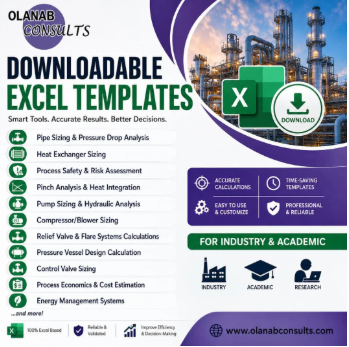
Download Engineering Design Kits & Process Equipment/Plant Design Excel Templates Here.
1. Start with Clearly Defined Requirements
A good process design begins with clearly defined requirements.
The process engineer needs to understand what the customer expects, what the product specification requires, what production capacity is necessary, and which statutory, regulatory, environmental, and safety requirements apply.
These requirements must then be translated into measurable engineering parameters.
For example, if a customer requires a product with a purity of 99%, the process design must provide the appropriate reaction, separation, purification, monitoring, and control systems to consistently achieve that specification.
Similarly, if the required production rate is 10 tonnes per day, the equipment and process configuration must be designed with sufficient capacity and appropriate operating margins.
The important point is that customer requirements must eventually become engineering requirements.
2. Understand the Process as a System
ISO 9001 emphasizes the process approach. For process engineers, this is particularly relevant because industrial operations are interconnected systems.
Consider a simplified chemical production process:
Raw Material → Preparation → Reaction → Separation → Purification → Storage → Packaging
Each stage affects the next.
A problem in raw-material preparation may affect the reactor. Reactor performance may affect separation. Separation performance may affect product purity. Product purity may ultimately affect customer satisfaction.
Therefore, process design should not focus only on individual equipment items. Engineers must understand the interfaces and interactions between processes.
A pump, for example, should not be selected simply because its flow rate matches the process requirement. Its pressure head, NPSH, control requirements, material compatibility, reliability, downstream effects, maintenance requirements, and impact on overall process performance must also be considered.
3. Apply Risk-Based Thinking
One of the most valuable ISO 9001 principles for process engineers is risk-based thinking.
Before finalizing a design, engineers should identify what could go wrong and determine how the design can prevent or minimize those failures.
This is where engineering tools such as FMEA, HAZOP, Fault Tree Analysis, What-If Analysis, and risk assessment become valuable.
For example, suppose a chemical dosing pump fails. The immediate consequence could be inadequate chemical dosing, which may result in off-specification product.
A risk-based design might therefore include a standby pump, automatic changeover, low-flow alarm, appropriate instrumentation, and preventive maintenance.
The objective is not simply to document the risk. The objective is to use the risk assessment to improve the design.
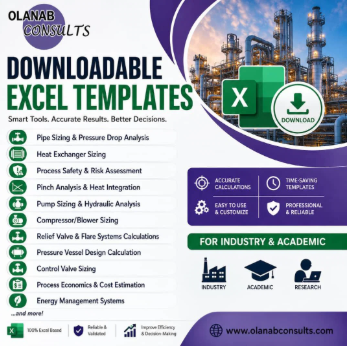
Download Engineering Design Kits & Process Equipment/Plant Design Excel Templates Here.
4. Design Quality Controls into the Process
A well-designed process should control quality at the point where variation is generated.
Instead of waiting until the final product is produced before checking quality, important process parameters should be monitored and controlled throughout production.
For example, depending on the process, temperature, pressure, flow rate, pH, concentration, residence time, moisture content, or other critical parameters may need to be continuously monitored.
This creates a fundamental shift from:
"Inspect the product and find the problem."
to:
"Control the process so that the problem is unlikely to occur."
This is one of the most important contributions of quality management to process engineering.
5. Integrate Instrumentation and Control
Instrumentation should not be treated as an afterthought.
Where a process parameter directly influences product quality, the measurement and control system should be considered during the design stage.
For example, if reaction temperature directly affects product quality, the design should consider the appropriate temperature sensor, measurement range, controller, control valve or heating system, alarm limits, interlocks, calibration requirements, and failure response.
An inaccurate instrument can make a well-designed process appear to be operating correctly when it is actually outside specification.
Therefore, measurement quality is an essential part of process quality.
6. Verify and Validate the Design
Another important aspect of applying ISO 9001 to process design is distinguishing between design verification and design validation.
Verification asks:
"Have we designed the process correctly against the specified requirements?"
This may involve engineering calculations, simulations, equipment sizing, design reviews, mass and energy balances, hydraulic calculations, and technical evaluations.
Validation asks a slightly different question:
"Will this process actually perform its intended function under realistic operating conditions?"
This may require commissioning trials, performance testing, pilot testing, product trials, or other appropriate demonstrations.
A process can pass theoretical calculations and still perform poorly when exposed to real operating conditions. Both verification and validation are therefore important.
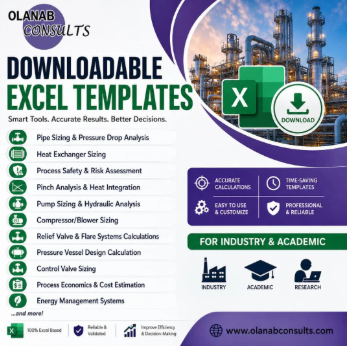
Download Engineering Design Kits & Process Equipment/Plant Design Excel Templates Here.
7. Make Design Reviews Multidisciplinary
Process design should not be reviewed exclusively by the person who developed it.
A strong design review brings together different perspectives.
Process engineers may focus on mass balances and operating conditions. Mechanical engineers may identify equipment or mechanical integrity concerns. Instrumentation engineers may identify control limitations. Production personnel may highlight operational difficulties. Maintenance personnel may identify accessibility and reliability issues. Quality personnel may identify risks to product conformity.
This multidisciplinary approach can identify problems that may not be visible from a single engineering discipline.
Good design is rarely the product of one person's perspective.
8. Control Design Changes
Industrial projects rarely proceed exactly according to the original design.
Equipment may become unavailable. Suppliers may propose alternatives. Production requirements may change. Costs may increase. New regulations may emerge.
However, every design change should be evaluated before implementation.
A seemingly minor change—such as replacing a pump, changing a material of construction, modifying an instrument, or altering a process parameter—can have consequences elsewhere in the system.
A controlled change-management process should therefore consider the technical, quality, safety, environmental, operational, and regulatory implications of significant changes.
9. Commissioning Is Part of Quality Assurance
The quality responsibility of the process designer does not end when the engineering drawings are completed.
Commissioning provides an opportunity to confirm that the process has actually been constructed and installed according to the approved design and that it performs as intended.
Equipment functionality, instrumentation, control systems, process parameters, product quality, and operating procedures should be evaluated against established requirements.
Performance data obtained during commissioning should also be captured as valuable feedback for future optimization.
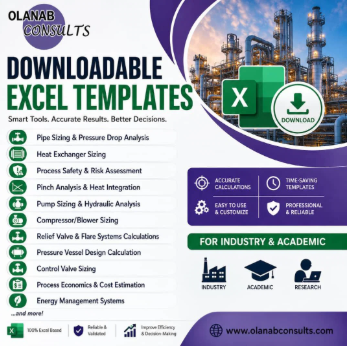
Download Engineering Design Kits & Process Equipment/Plant Design Excel Templates Here.
10. Use Data for Continual Improvement
ISO 9001 emphasizes continual improvement.
Once a process is operational, engineers should not simply assume that the original design is permanently optimal.
Actual operating data can reveal opportunities for improvement in:
- productivity;
- energy consumption;
- product yield;
- equipment reliability;
- waste generation;
- process variability;
- maintenance;
- operating cost.
For example, a process may have been designed for a particular operating temperature, but historical production data may demonstrate that a slightly different operating range provides better product quality and lower energy consumption.
This is where process engineering, data analysis, statistical process control, Lean Six Sigma, and continuous improvement come together.
ISO 9001 Should Not Be Treated as "Paperwork"
One of the biggest misconceptions about ISO 9001 is that implementation is primarily about producing documents for auditors.
Documentation is important, but it is not the ultimate objective.
The real objective is to establish a system in which processes are defined, controlled, measured, evaluated, and continually improved.
For process engineers, this means that ISO 9001 should influence how we develop process designs, select equipment, assess risks, establish control strategies, verify calculations, manage changes, commission facilities, and evaluate operational performance.
In other words, ISO 9001 should become part of the engineering culture rather than something that exists separately from engineering.
Integrating ISO 9001 with Engineering Tools
ISO 9001 does not replace engineering methodologies. Instead, it can provide a management framework within which those methodologies can operate effectively.
For example, FMEA can be used to identify potential process failures, HAZOP can evaluate process deviations, SPC can monitor process variation, OEE can measure equipment performance, and Lean Six Sigma can reduce waste and variation.
When these tools are integrated into an ISO 9001-based management system, the organization moves from simply responding to quality problems toward systematically preventing them.
A Practical Process Design Philosophy
A useful way to think about ISO 9001 in process design is:
Define → Design → Assess → Verify → Validate → Control → Measure → Improve
First, define what the process must achieve.
Then design the process around those requirements.
Assess what could go wrong.
Verify that the engineering design meets its requirements.
Validate that the completed process works under realistic conditions.
Control the process during operation.
Measure its performance.
Then use the evidence obtained to improve it.
This creates a continuous feedback loop between engineering design and operational performance.
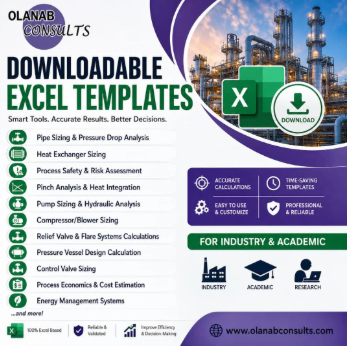
Download Engineering Design Kits & Process Equipment/Plant Design Excel Templates Here.
Conclusion
Applying ISO 9001 to process design changes the way quality is approached in industrial engineering.
Instead of viewing quality as something checked after production, quality becomes an integral part of the process itself.
A properly designed process should be capable of producing the required output consistently, safely, efficiently, and within defined specifications. Achieving this requires more than good equipment. It requires clearly defined requirements, risk-based design, appropriate instrumentation, effective controls, multidisciplinary reviews, design verification and validation, controlled changes, reliable documentation, performance monitoring, and continual improvement.
Ultimately, the strongest quality system is one in which the process itself is designed to prevent failure.
For process engineers, this is perhaps the most important lesson from ISO 9001:
Don't design a process and then ask how to control its quality. Design the process so that quality is built into the way it operates.
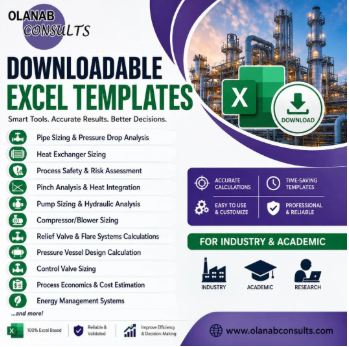
Download Engineering Design Kits & Process Equipment/Plant Design Excel Templates Here.